industrial tank scrap removal Dammam: 6 Smart, Essential Steps
Industrial storage tanks are large, heavy assets that require more planning than ordinary scrap collection. For businesses seeking industrial tank scrap removal Dammam, the immediate priorities are identifying the tank material, confirming its former contents, making the equipment safe, and establishing how it can be dismantled and loaded. A clear scope helps prevent delays and supports an accurate scrap assessment.
Metal Scrap Dammam assists factories, contractors, warehouses, and facility teams with evaluating redundant tanks and coordinating suitable collection arrangements. Tanks should never be treated as simple empty containers: residues, connected pipework, internal pressure, insulation, restricted access, and lifting requirements can all affect the removal plan.
What Industrial Storage Tank Scrap Includes
Storage tanks may be vertical or horizontal, fixed to foundations, mounted on supports, or incorporated into a production system. Their recoverable value depends largely on the metal composition and the amount of non-metallic material attached. Common tank-related scrap includes:
- Carbon steel tanks: Often recognized by magnetic steel shells, painted surfaces, welded seams, and areas of oxidation where coatings have deteriorated.
- Stainless steel tanks: Used where corrosion resistance or hygienic surfaces are important. The grade should be verified rather than assumed from appearance alone.
- Non-ferrous components: Aluminum panels, copper cables, brass valves, and other fittings may be present around the main tank structure.
- Associated equipment: Steel platforms, ladders, pipe sections, pumps, agitator housings, flanges, brackets, and support frames may form part of the clearance scope.
Insulation, rubber linings, coatings, sludge, product residue, concrete foundations, and mixed attachments are not equivalent to clean metal. Separating these materials where safe and practical can make the load easier to assess and process.
How to Plan industrial tank scrap removal Dammam
A successful project starts before any cutting or lifting begins. The following six steps give site managers and contractors a practical framework for preparing a redundant storage tank.
- Confirm the tank’s history and status. Record its former contents, operating purpose, approximate dimensions, capacity, construction material, and current condition. The responsible site team should confirm that the tank has been taken out of service and isolated from active pipes, electrical supplies, pressure sources, and connected equipment.
- Arrange safe emptying and cleaning. A tank that looks empty may still contain liquid, sludge, vapour, scale, or an internal lining. Cleaning and gas-free verification should be handled by competent parties appropriate to the former contents. Scrap workers should not cut, heat, or enter a tank until the site has confirmed that it is safe for the agreed work.
- Identify and sort the metals. Review equipment records, identification plates, magnetic response, corrosion patterns, and exposed surfaces. Separate stainless steel parts, carbon steel shells, aluminum cladding, copper cable, and brass valves when this can be done safely. Avoid mixing removed insulation or general waste into a metal load.
- Inspect access and working space. Measure gates, internal roads, overhead clearance, turning areas, and the distance between the tank and the loading point. Note nearby buildings, live services, pipelines, drains, or production areas. Restricted access may change the required cutting sequence, lifting equipment, vehicle type, and collection schedule.
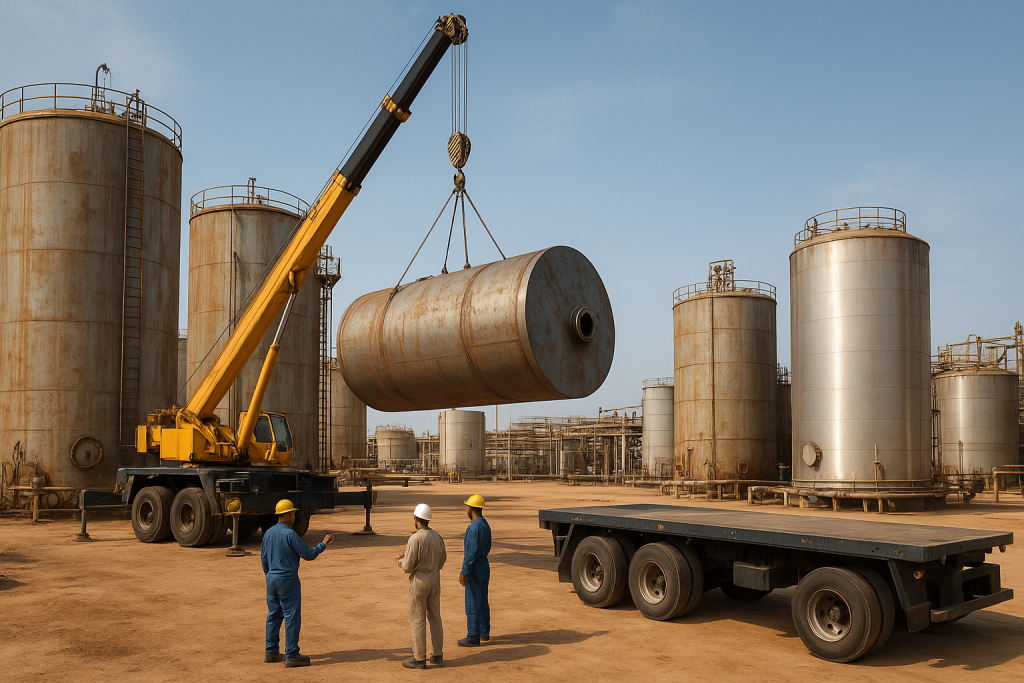
- Define dismantling and lifting responsibilities. Agree who will disconnect pipework, remove anchors, dismantle platforms, cut the shell, provide lifting equipment, and manage site supervision. Large sections may require a crane, while smaller prepared pieces may suit a forklift or other loading equipment. The method must reflect actual site conditions and tank weight.
- Prepare information for assessment. Supply clear photographs, dimensions, estimated quantity, suspected metal grade, contamination details, and loading conditions. Mention whether the tank is intact, already dismantled, indoors, elevated, or fixed to a concrete base. Better information allows the scrap buyer to evaluate both the metal and the work required for collection.
How Tank Scrap Is Evaluated
There is no responsible way to quote every storage tank at one standard rate. Carbon steel, stainless steel, and non-ferrous attachments belong to different scrap categories, while the cost and complexity of removal vary from site to site. Current market conditions also influence metal values.
- Material type and grade: Carbon steel and verified stainless steel grades are assessed differently.
- Recoverable metal quantity: Dimensions alone may not reveal shell thickness, internal structures, or total metal weight.
- Condition: Severe corrosion, trapped material, and damaged sections can affect handling and recovery.
- Contamination: Residue, insulation, coatings, rubber, concrete, and mixed waste may require separation.
- Preparation: Clean, sorted, accessible pieces are generally simpler to assess than an intact connected tank.
- Removal requirements: Cutting, lifting, labour, transport access, and loading arrangements affect the overall quotation.
For an informed industrial tank scrap removal Dammam assessment, provide site-specific details rather than relying only on a rough capacity estimate. Metal Scrap Dammam can review the available information and explain what additional photographs, measurements, or access details may be needed for a current quotation.
Collection, Loading, and Industrial Coordination
Tank collection should be coordinated with the facility’s operations and safety controls. Before arrival, the parties should confirm the collection area, authorized access time, vehicle route, loading method, site contact, and whether any dismantling has already been completed. Tanks located inside process areas may require more coordination than units positioned in an open storage yard.
For industrial tank scrap removal Dammam, the agreed scope should distinguish between scrap collection and specialist activities such as hazardous-residue treatment, confined-space work, or technical decommissioning. Once the tank is safe and ready, prepared sections can be sorted, loaded, transported, and evaluated according to their material category and the agreed commercial terms.
Practical Considerations for Dammam Industrial Sites
Dammam’s factories, workshops, logistics properties, construction compounds, and industrial areas can present very different access conditions. A tank in an open equipment yard may be reachable by a suitable truck, while a tank inside an operating plant may be surrounded by pipe racks, walls, utilities, or production traffic. Planning industrial tank scrap removal Dammam therefore requires attention to gate dimensions, loading space, site procedures, and the safest practical removal sequence.
Eastern Province heat, dust, and active industrial traffic can also affect scheduling and site preparation. Facility teams should keep access routes clear, identify stable ground for loading equipment, and coordinate the work with other contractors. These practical details help reduce avoidable waiting and make the collection process more predictable.
Responsible Recycling of Storage Tank Metal
Recycling a retired tank can return carbon steel, stainless steel, copper, brass, and aluminum to material recovery streams instead of treating the entire asset as mixed waste. Effective sorting improves identification and helps prevent insulation, residue, packaging, or demolition debris from contaminating recyclable metal.
Responsible material management also supports broader goals related to resource conservation and waste reduction. The UN Environment Programme provides wider information about environmental responsibility and sustainable resource use. At the site level, practical action starts with safe decommissioning, careful segregation, and delivery of recoverable metals to appropriate recycling channels.
Frequently Asked Questions
Can a tank be collected if it still contains residue?
A tank with liquid, sludge, vapour, or an unidentified substance should not be presented as ordinary prepared scrap. The site owner should identify the former contents and arrange suitable emptying, cleaning, isolation, and safety verification through competent parties before cutting or collection is considered.
How can we identify whether a tank is carbon steel or stainless steel?
Equipment records and original material specifications are useful starting points. Magnetic response, corrosion appearance, identification plates, and exposed metal can provide clues, but appearance alone may be misleading. Where grade affects the assessment, material verification may be needed before final classification.
Can valves, ladders, pipework, and platforms be included?
Associated metal components can often be considered as part of the project when they are disconnected and included in the agreed scope. Carbon steel, stainless steel, copper, brass, and aluminum items should be separated where practical. Non-metallic insulation, gaskets, residue, and general waste require separate consideration.
What information is needed to quote industrial tank scrap removal Dammam?
Provide photographs from several angles, tank dimensions, quantity, location within the site, suspected material, former contents, cleaning status, attached equipment, and access conditions. Also explain whether the tank is intact or dismantled and what lifting or loading equipment is available on site.
Request a Storage Tank Scrap Assessment
Careful preparation protects the site, clarifies responsibilities, and enables a more useful evaluation of the recoverable metal. To discuss industrial tank scrap removal Dammam, share tank photographs, dimensions, material information, former-use details, and access requirements with Metal Scrap Dammam.
Visit Metal Scrap Dammam services, call or WhatsApp +966532510699, or email info@metalscrapdammam.com to request a current, site-relevant quotation.