A Practical Guide to steel drum recycling Dammam
Businesses searching for steel drum recycling Dammam usually need a practical way to remove empty industrial drums, understand whether they qualify as recyclable steel, and arrange collection without disrupting operations. The process starts with identifying each container and its previous contents. Drums must then be checked for residue concerns, sorted by construction and condition, counted, and positioned for safe assessment or loading. Metal Scrap Dammam can review the supplied details and discuss an appropriate collection or evaluation plan for commercial quantities.
Understanding Empty Steel Drums as Industrial Scrap
Industrial steel drums are commonly manufactured from carbon or mild steel. They may have a closed head with small filling openings or a removable open head secured by a ring. Some drums are galvanized, lined internally, fitted with steel or non-ferrous components, or made from stainless steel for specialized applications. Construction affects identification and potential scrap classification, so drums should not automatically be treated as one uniform grade.
A drum described as empty can still contain residue, sludge, vapour, liners, labels, seals, or contaminated absorbent material. Its previous contents are therefore as important as the metal shell. Product labels, safety data sheets, and internal waste records can help establish what the container held. Unknown or hazardous residues may require specialist handling rather than ordinary scrap collection. Never cut, weld, puncture, compact, or heat an unidentified drum.
6 Smart, Essential Steps for steel drum recycling Dammam
Good preparation helps a scrap buyer understand the material and plan labour, transport, loading, and site access. Use these six steps before requesting an assessment.
- Build an accurate drum inventory. Record the approximate number of drums, their capacities or dimensions, and whether they are open-head or closed-head containers. Note any unusual drums, heavy damage, internal liners, removable lids, or mixed-metal fittings. A clear inventory is more useful than a broad estimate, especially when several warehouse or production areas are involved.
- Confirm previous contents and residue status. Retain readable labels and relevant safety information until the contents have been identified. Separate drums with unknown contents, liquid, sludge, strong odours, or visible residue from verified-empty containers. Do not pour residue onto the ground or into drainage systems, and do not rinse containers unless an appropriate controlled procedure has been established by the site.
- Sort by material and condition. Keep ordinary carbon-steel drums apart from stainless, galvanized, composite, or plastic containers. Drums containing plastic liners or significant non-metal attachments should be identified separately. Group intact containers, crushed shells, heavily corroded drums, and loose lids where practical. Better sorting supports clearer evaluation and more efficient handling.
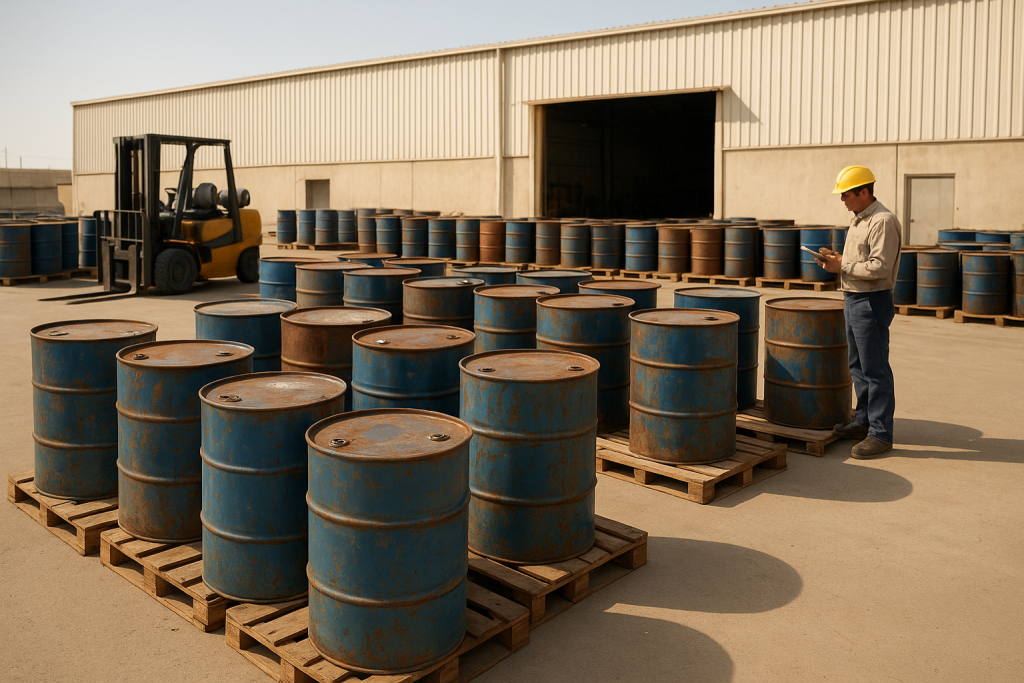
- Keep containers stable and accessible. Store drums on a level area away from active vehicle routes, ignition sources, and incompatible materials. Prevent unstable stacking and maintain access for inspection or mechanical loading. If drums are on pallets, check that the pallets are serviceable and that the load can be approached by the equipment intended for removal.
- Share useful evidence before collection. Provide photographs showing the drum bodies, openings, labels, storage arrangement, corrosion, residue, and access route. Include the site location, estimated quantity, preferred collection window, and available loading equipment. Mention stairs, narrow gates, restricted vehicle areas, security procedures, or other conditions that could affect removal.
- Coordinate assessment and pickup. The buyer can review material details, quantity, segregation, and collection requirements before confirming the next step. Site representatives should agree on loading responsibilities, entry rules, contact personnel, and where the vehicle may park. This preparation makes steel drum recycling Dammam easier to plan for factories, workshops, contractors, and warehouses.
How Empty Steel Drums Are Evaluated
There is no responsible way to determine a current quotation from drum count alone. Evaluation may consider the recoverable metal, the preparation completed by the seller, and the work required to collect the material.
- Metal type: Carbon steel, galvanized steel, and stainless steel may require different classification.
- Residue and contamination: Liquids, sludge, coatings, liners, and unknown substances can affect suitability and handling.
- Condition: Corrosion, sealed openings, deformation, sharp edges, and trapped material influence processing requirements.
- Sorting quality: Separate steel grades and isolated non-metal components can make assessment clearer.
- Quantity: The number, size, and estimated weight of the drums affect collection planning.
- Removal requirements: Labour, loading equipment, access restrictions, and transport needs are relevant logistical factors.
Market conditions for steel scrap can also change. For steel drum recycling Dammam quotations, provide current photographs and an honest description rather than relying on an old rate or an estimate for a different material. Metal Scrap Dammam can then review the available information and explain what else is needed for assessment.
Planning steel drum recycling Dammam Collection
Dammam businesses may accumulate empty drums through manufacturing, maintenance, coatings, lubricants, chemicals, construction support, or warehouse operations. Industrial access conditions vary, so collection planning should reflect the actual site. A small ground-level batch requires different arrangements from multiple stacks distributed across a production facility or storage compound.
Before the vehicle arrives, nominate a site contact and confirm gate-entry requirements, working hours, loading controls, and the designated collection zone. Keep verified-empty recyclable drums separate from containers awaiting residue investigation. If a forklift, pallet jack, crane, or site labour is available, state this during the enquiry rather than assuming it will be used. Businesses can review Metal Scrap Dammam services and submit accurate material and access details for collection planning in Dammam and relevant Eastern Province locations.
Responsible Recovery and Recycling Context
Once suitable drums enter a legitimate metal recovery stream, the steel can be segregated, processed, and supplied as recyclable feedstock. This keeps recoverable metal in productive use and can reduce avoidable disposal. The wider principles of resource efficiency and responsible waste management are discussed by the UN Environment Programme.
Responsible recovery does not mean treating every empty-looking container as ordinary steel scrap. Identification and residue control come first. Businesses should preserve records, follow their internal environmental and safety procedures, and use an appropriate specialist route when contents are hazardous, unknown, or unsuitable for metal collection.
Frequently Asked Questions
Can steel drums with residue be collected as scrap?
That depends on the substance, quantity of residue, drum condition, and applicable handling requirements. Clearly separate affected drums and provide labels, safety information, and photographs. Unknown, hazardous, or significant residue may need specialist treatment before the metal can be considered for ordinary scrap collection.
Should we remove drum lids, caps, or internal liners?
Do not dismantle a drum if doing so could expose workers to residue, vapour, sharp edges, or pressure. For verified-empty and safe containers, loose lids or removable liners can be identified separately. Ask the buyer about preparation expectations before crushing, cutting, or modifying any drum.
How do I arrange steel drum recycling Dammam for a commercial quantity?
Send the drum count, material type, previous contents, condition, photographs, site location, and access details to Metal Scrap Dammam. Explain whether drums are palletized and what loading equipment is available. These details help determine whether further inspection or collection planning is required.
What information is needed for a steel drum quotation?
Useful information includes drum size, quantity, steel type, residue status, sorting, corrosion, liners, attachments, and estimated weight if known. Collection-floor level, vehicle access, labour needs, and loading arrangements are also relevant. Current market conditions are considered when a quotation is prepared.
Request an Empty Steel Drum Assessment
For practical steel drum recycling Dammam support, prepare an inventory, keep uncertain containers isolated, and share clear photographs with the collection details. Metal Scrap Dammam can review empty industrial drum quantities and discuss assessment, pickup, and removal requirements without relying on unsupported price assumptions.
Contact Metal Scrap Dammam: Website: https://metalscrapdammam.com/ | Call / WhatsApp: +966532510699 | Email: info@metalscrapdammam.com