heat exchanger recycling Dammam: 6 Smart, Essential Steps
Retired heat exchangers can be heavy, contaminated, difficult to access, and made from several valuable metal grades. A practical heat exchanger recycling Dammam service should therefore cover more than scrap collection. It requires equipment identification, safe isolation, material assessment, site planning, loading coordination, and delivery for appropriate metal recovery.
Metal Scrap Dammam works with factories, contractors, workshops, warehouses, and facility teams seeking a practical route for removing unwanted industrial equipment. Customers can contact Metal Scrap Dammam services to discuss the exchanger type, quantity, condition, and collection requirements.
Understanding Industrial Heat Exchanger Scrap
A heat exchanger transfers heat between liquids, gases, refrigerants, steam, or process media without intentionally mixing the separate streams. Once an exchanger becomes damaged, inefficient, obsolete, or surplus to a plant upgrade, its recoverable value depends largely on its construction rather than its former operating capacity.
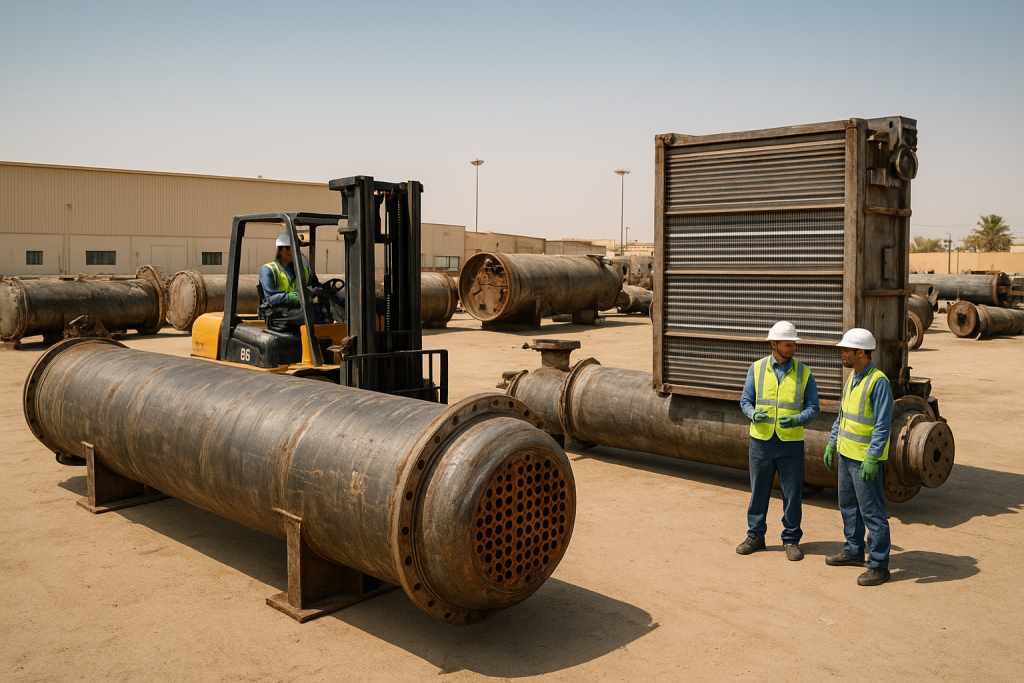
Shell-and-tube units may combine a carbon steel shell with copper, brass, copper-nickel, stainless steel, or other alloy tubes. Plate exchangers commonly contain stainless steel or specialty-alloy plates held within a steel frame. Air-cooled units can include aluminum fins, copper tubes, steel supports, motors, and fan assemblies.
This mixed construction matters because ferrous and non-ferrous metals are evaluated differently. Steel is magnetic and generally separated from copper-bearing tubes, aluminum fins, brass fittings, or stainless plates. Accurate identification helps prevent a mixed unit from being assessed as one undifferentiated piece of machinery scrap.
Heat Exchanger Types That May Require Removal
An industrial recycling enquiry may involve complete units, damaged sections, loose bundles, plates, coils, or components removed during maintenance and plant clearance. Common examples include:
- Shell-and-tube exchangers, condensers, evaporators, and removable tube bundles
- Gasketed, brazed, welded, or frame-mounted plate heat exchangers
- Air-cooled process exchangers with finned tubes and steel structures
- Oil coolers, compressor coolers, chiller components, and industrial HVAC coils
Photographs, equipment labels, dimensions, and known material specifications can help distinguish these items before collection. Labels should be treated as useful evidence rather than the only basis for determining metal grade.
How heat exchanger recycling Dammam Works in 6 Steps
A structured process reduces uncertainty and helps the customer, removal team, and site representative prepare for the work.
- Identify the equipment: Record the exchanger type, approximate dimensions, quantity, operating history, and visible metal components. Wide-angle photographs should show the complete unit, while close images can document tube ends, plates, fins, fittings, frames, and identification plates.
- Confirm isolation and draining: The equipment should be disconnected from active process lines, electrical supplies, pressure sources, and connected systems. Residual liquids, oils, refrigerants, chemicals, sludge, or scale must be identified and managed appropriately before scrap handling begins.
- Assess the metal composition: Determine whether the main recoverable components are carbon steel, stainless steel, copper, brass, copper-nickel, aluminum, or a combination. Where the grade is uncertain, keep supporting maintenance records or material specifications available for assessment.
- Plan access and lifting: Check door widths, overhead restrictions, floor loading, crane access, forklift routes, loading zones, and vehicle entry requirements. A compact exchanger in a congested plant room may require more planning than a larger unit already positioned outdoors.
- Review the quotation basis: Evaluation should account for recoverable material, condition, contamination, quantity, separation, market conditions, and removal requirements. The agreed scope should clarify whether equipment is collected whole or prepared into manageable sections beforehand.
- Coordinate loading and recycling: Confirm the collection point, site contact, access timing, induction requirements, and lifting responsibilities. After loading, the exchanger can be directed into a recycling stream where reusable ferrous and non-ferrous fractions are separated and processed.
What Affects Scrap Evaluation?
There is no reliable universal rate for every exchanger. Two units of similar size may contain different tube alloys, levels of contamination, or amounts of recoverable metal. Important evaluation factors include:
- Metal type and grade: Copper-bearing tubes, stainless plates, aluminum fins, and carbon steel shells have different recycling classifications.
- Purity and separation: Clearly separated components are easier to classify than mixed assemblies containing insulation, rubber, plastic, or attached machinery.
- Condition and contamination: Process residue, heavy scale, oil, coatings, moisture, and non-metal attachments can affect handling and recoverable yield.
- Quantity and dimensions: The number, weight, shape, and transportability of the units influence collection planning.
- Site requirements: Restricted access, cutting needs, lifting equipment, permits, and loading distance can affect the removal scope.
For a current heat exchanger recycling Dammam quotation, provide honest information about both the metal and the work required. A site review may be useful when dimensions, composition, or access cannot be understood from photographs.
Preparing a Heat Exchanger for Collection
Do not cut into equipment that remains connected, pressurized, hot, electrically energized, or filled with an unknown substance. The site operator should confirm shutdown status and identify any previous process media. Refrigerant, hazardous residue, or regulated material should be handled by appropriate personnel before metal removal.
- Keep different exchangers and loose metal grades separated where practical.
- Remove detachable non-metal packaging, loose debris, and external waste without disturbing unsafe residue.
- Mark heavy or awkward lifting points and communicate known weight information to the collection team.
Small components should be placed in suitable containers rather than scattered around the loading area. Tube bundles, plates, shells, and frames should remain identifiable so their composition can be reviewed without unnecessary mixing.
Industrial Removal in Dammam
Dammam’s industrial environment includes process facilities, fabrication workshops, maintenance contractors, warehouses, utility systems, and manufacturing operations. Heat exchanger removals in industrial areas may involve controlled vehicle entry, security procedures, busy loading zones, and coordination with maintenance shutdowns.
For heat exchanger recycling Dammam projects, customers should share gate restrictions, collection hours, equipment location, lifting availability, and site-contact details in advance. Similar industrial requirements can arise elsewhere in the Eastern Province, but Dammam remains the primary service market and planning focus.
Responsible Metal Recovery
Recycling an exchanger can return steel, stainless steel, copper alloys, and aluminum to material-processing streams while reducing avoidable disposal. Effective recovery begins with draining, contamination control, accurate sorting, and the separation of metal from gaskets, insulation, coatings, or other non-metal parts.
Responsible heat exchanger recycling Dammam planning also supports broader waste-reduction and resource-conservation principles discussed by the UN Environment Programme. The practical priority is to route recoverable material appropriately without overlooking worker safety or residual process substances.
Frequently Asked Questions
Can complete heat exchangers be collected without dismantling?
Collection of a complete unit may be possible when it is safely isolated, accessible, transportable, and suitable lifting equipment is available. Large exchangers, fixed structures, or units inside restricted plant rooms may need an agreed removal or sectioning plan before collection.
Should copper tubes and stainless plates be separated first?
Separation can improve material identification, but customers should not dismantle equipment if cutting creates safety, contamination, or lifting risks. Share photographs first so the construction, likely grades, and practical benefit of separation can be reviewed.
What information is needed to assess an exchanger?
Provide the unit type, quantity, dimensions, approximate weight if known, metal specifications, photographs, condition, previous application, contamination status, and location within the site. Also explain whether a forklift, crane, loading bay, or clear vehicle route is available.
How can an industrial site request a quotation and pickup?
To request heat exchanger recycling Dammam, send the available equipment and access details to Metal Scrap Dammam by WhatsApp or email. The information can be reviewed to clarify material assessment, preparation, collection, and loading requirements without relying on an invented standard rate.
Arrange Heat Exchanger Assessment and Removal
Turn retired exchangers into organized industrial scrap rather than leaving heavy mixed-metal equipment to occupy valuable plant or storage space. For heat exchanger recycling Dammam enquiries, contact Metal Scrap Dammam to discuss the unit type, composition, quantity, condition, access, and required collection scope.
Website: https://metalscrapdammam.com/
Call / WhatsApp: +966532510699
Email: info@metalscrapdammam.com