industrial pipe scrap removal Dammam: A Practical Site Guide
Decommissioned pipes can occupy valuable production, workshop, warehouse, and project space. For factories, contractors, and facility teams, industrial pipe scrap removal Dammam involves identifying the metal, checking for contamination, planning access, and coordinating suitable loading. A clear process helps prevent mixed grades, unnecessary handling, and collection delays while allowing the piping to be assessed according to its recoverable material.
Metal Scrap Dammam can review information about redundant process lines, structural pipe, fabrication offcuts, and dismantled piping assemblies. Businesses can use Metal Scrap Dammam services to discuss material details, site conditions, and collection requirements before arranging removal.
Understanding Industrial Piping Scrap
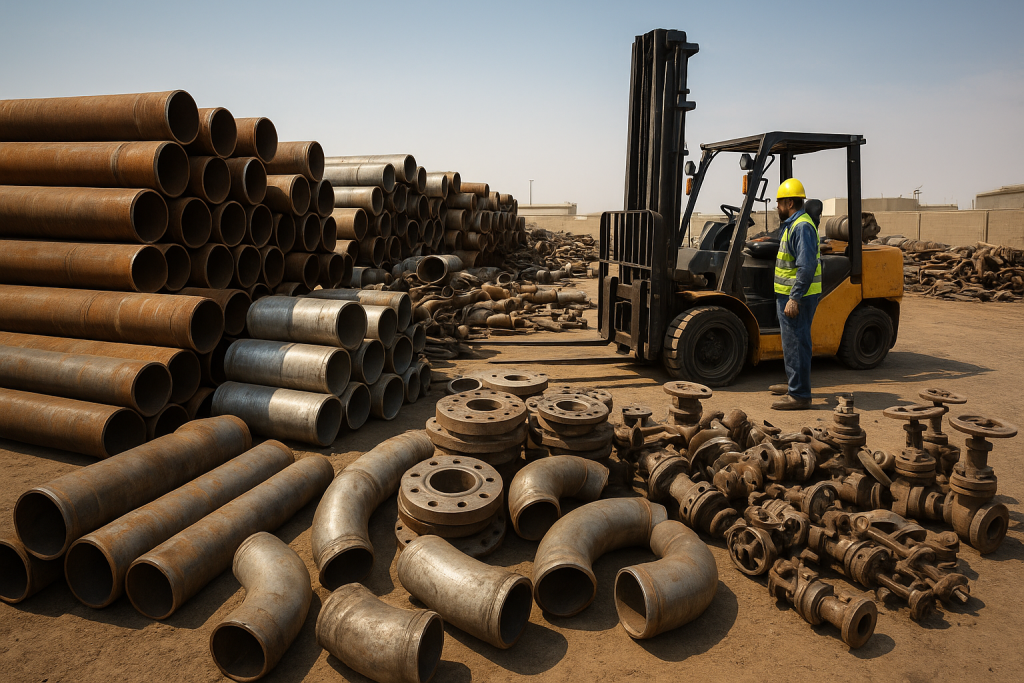
Industrial pipe scrap is not a single uniform material. Carbon steel is common in process plants, fabrication shops, utilities, construction projects, and mechanical installations. Other systems may contain stainless steel, galvanized steel, copper, brass fittings, or specialized alloy sections. Flanges, valves, supports, gaskets, coatings, and insulation can also affect how a load should be separated and assessed.
- Carbon steel pipe: Usually ferrous and magnetic, with possible paint, scale, oxidation, welds, or attached steel flanges.
- Stainless steel pipe: May require grade identification because appearance and magnet response alone do not always confirm composition.
- Non-ferrous piping: Copper pipe, brass valves, and related fittings should normally be separated from iron and steel.
- Mixed assemblies: Pipe racks, valves, insulation, rubber, plastic liners, and instrumentation may require additional preparation.
Condition matters, but rust does not automatically make steel unrecyclable. The important questions are what metal is present, whether residual substances remain, how much non-metallic material is attached, and whether the pipe can be handled efficiently.
6 Practical Steps for industrial pipe scrap removal Dammam
The following six steps help industrial teams prepare a clearer collection request and reduce avoidable movement on site.
- Identify the piping and its previous use. A successful industrial pipe scrap removal Dammam project starts with an inventory. Record approximate diameters, wall thicknesses, lengths, quantities, and likely metal types. Note whether the material came from water, air, oil, chemical, gas, steam, or drainage service. Previous use is important because apparently empty piping may still contain residue or trapped liquid.
- Confirm isolation and decommissioning. Scrap collection should begin only after the site owner or responsible contractor has confirmed that pipes are disconnected, depressurized, drained, and released for removal. Unknown residues, insulation, or regulated materials need assessment under the site’s own procedures. Scrap handlers should not be expected to disconnect active lines or determine process safety without prior coordination.
- Separate valuable metal categories. Keep stainless steel, copper, brass fittings, and identifiable alloys apart from ordinary carbon steel wherever practical. Remove loose plastic, rubber, timber, packaging, and general waste. Sorting supports a more accurate evaluation because a clean, identifiable grade can be reviewed differently from a mixed pile containing several metals and contaminants.
- Prepare manageable sections and bundles. Very long pipe can be difficult to load, secure, and transport. Discuss acceptable dimensions before cutting because required lengths depend on access, lifting equipment, and vehicle configuration. Stable bundles can simplify counting and movement, but they should not conceal mixed grades or unwanted contents. Avoid cutting sealed sections until their condition is understood.
- Plan access and loading requirements. Check gate dimensions, internal roads, overhead restrictions, ground conditions, parking space, and the distance between the pipe stack and loading area. Confirm whether a forklift, crane, loader, lifting straps, or additional labor is available. Clear photographs of the material and access route can help determine the likely collection arrangement before a vehicle is scheduled.
- Share accurate details for assessment. Provide the site location, contact person, estimated quantity, metal types, pipe lengths, contamination status, and preferred collection window. Mention permits, inductions, personal protective equipment rules, or restricted working hours. Accurate information helps the scrap buyer consider both recoverable metal and the work required to remove it from the industrial site.
How Pipe Scrap Is Evaluated
For industrial pipe scrap removal Dammam, evaluation is based on more than the visible size of the pile. A buyer may need photographs, markings, a site inspection, or material testing when the grade is uncertain. Current market conditions also influence quotations, so an old rate or an unrelated metal price should not be treated as a reliable guide.
- Metal category and identifiable grade
- Purity and separation from other metals
- Residual contents, coatings, insulation, or liners
- Total quantity and consistency of the load
- Cutting, lifting, access, labor, and transport requirements
Weighing or quantity confirmation can be discussed as part of the collection arrangement. For a current quotation, provide Metal Scrap Dammam with honest details about both the material and the site rather than relying on an approximate weight alone.
Industrial Collection in Dammam
Planning industrial pipe scrap removal Dammam requires attention to the operating environment. Industrial sites may have controlled gates, active production traffic, designated lifting zones, or limited collection windows. Pipe from a fabrication shop may be loose and clean, while material from a plant shutdown may include flanges, supports, insulation, and mixed process components.
In Dammam and the wider Eastern Province industrial context, early coordination helps match the collection method to the load. Site teams should identify a responsible contact, keep loading routes clear, and advise whether the material is at ground level, inside a workshop, on a rack, or in a restricted area.
Responsible Recycling and Material Recovery
Once accepted piping is sorted and processed, its metal can return to established recycling streams instead of remaining as unmanaged industrial waste. Separating ferrous steel from stainless steel and non-ferrous fittings improves material recovery and reduces contamination during downstream processing.
Responsible metal management also supports broader waste-reduction and resource-conservation goals discussed by the UN Environment Programme. Site owners can contribute by documenting decommissioned material, preventing mixing with general waste, and disclosing known contamination before collection.
Frequently Asked Questions
What types of industrial pipe scrap can be assessed?
Carbon steel, stainless steel, galvanized pipe, copper pipe, brass fittings, fabrication offcuts, flanges, and mixed piping assemblies may be assessed. Acceptance depends on identification, condition, contamination, quantity, and the practical requirements of collection.
How is industrial pipe scrap removal Dammam evaluated?
Evaluation generally considers metal type, grade, purity, quantity, sorting, attached materials, market conditions, and removal requirements. Photos and accurate site information can support an initial review, while uncertain alloys may require closer inspection.
Must all pipes be cut before collection?
Not necessarily. Suitable dimensions depend on pipe length, diameter, vehicle access, and available lifting equipment. Discuss cutting before starting work, especially when sections are sealed, contaminated, lined, unusually heavy, or still connected to other equipment.
What information is needed to arrange collection?
Share the Dammam site location, estimated quantity, likely metal grades, pipe dimensions, photographs, access conditions, loading support, and contamination status. Also mention gate procedures, induction requirements, and suitable collection times.
Request an Industrial Pipe Scrap Assessment
For practical industrial pipe scrap removal Dammam, prepare photographs, material details, estimated quantities, and access information before requesting a quotation. Contact Metal Scrap Dammam through https://metalscrapdammam.com/ to discuss your piping scrap and collection needs. Call / WhatsApp: +966532510699 or email info@metalscrapdammam.com.