Selling Obsolete Forklifts: scrap forklift buyer Dammam Guide
An obsolete forklift can occupy valuable floor space, restrict warehouse movement, and deteriorate if it remains unmanaged. If you are seeking a scrap forklift buyer Dammam businesses can contact, start by identifying the machine, disclosing its condition, and planning removal around its weight, battery, fluids, and site access. Even a non-running unit may contain recoverable steel, cast iron, copper, aluminum, and serviceable components.
A forklift should not be treated as a simple block of mixed metal. Its counterweight, mast, forks, hydraulic system, power source, attachments, and possible contaminants affect evaluation and removal. Providing accurate information helps the buyer plan suitable loading equipment and discuss a quotation without relying on assumptions.
What Is Contained in an Obsolete Forklift?
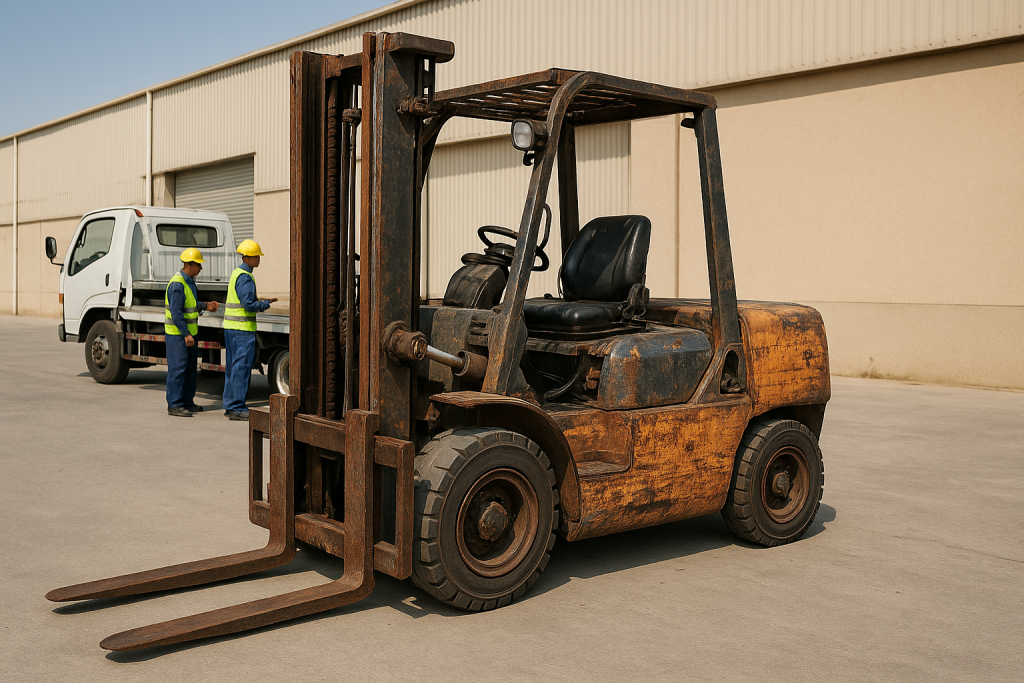
Most counterbalance forklifts contain a substantial ferrous-metal structure. The mast, carriage, forks, chassis, wheel assemblies, and many hydraulic components are primarily steel. The rear counterweight is commonly cast iron or another dense ferrous construction. Electric models can also contain copper-bearing motors, cables, contactors, and controllers, while combustion models may include an engine, starter, alternator, radiator, and exhaust components.
Non-ferrous metals may be present in wiring, radiators, motor windings, and selected housings, but the recoverable amount varies by model and completeness. Batteries, oils, coolant, fuel, LPG cylinders, filters, rubber tyres, seats, and plastic covers require separate consideration. A lead-acid or lithium-ion traction battery should be identified accurately rather than included as unidentified mixed scrap.
How a scrap forklift buyer Dammam Evaluates an Obsolete Unit
Evaluation is based on more than the forklift’s visible size. The buyer may need photographs, identification details, an approximate weight or capacity, and information about missing parts. The following factors commonly influence a quotation:
- Forklift type: electric, diesel, petrol, LPG, reach truck, or counterbalance unit.
- Metal composition: estimated ferrous and non-ferrous content in the complete machine.
- Condition: complete, dismantled, fire-damaged, corroded, leaking, or missing major assemblies.
- Battery and fluids: battery chemistry, fuel status, hydraulic oil, coolant, and visible leaks.
- Quantity: one machine or several forklifts included in a wider equipment clearance.
- Removal needs: access restrictions, lifting requirements, distance, and current market conditions.
No fixed rate applies to every forklift. Recoverable material, contamination, sorting, market conditions, and collection costs can all affect the final evaluation. Current details should therefore be supplied when requesting a quotation.
7 Essential Steps Before Selling a Forklift for Scrap
-
Record the machine details. Note the forklift type, rated capacity, approximate weight if known, power source, model information, and whether it starts, rolls, steers, or brakes. Photograph the whole machine, mast, forks, counterweight, battery compartment, engine area, and identification plate.
-
Confirm ownership and release status. Make sure the forklift belongs to the selling business and is formally released from operations. Remove business inventory labels only when appropriate, and retain serial or asset information needed for internal disposal records.
-
Stabilize the equipment safely. If site procedures allow, lower the forks, apply the parking brake, switch off the machine, and isolate its energy source through competent personnel. Do not attempt to start, tow, cut, or dismantle an unstable forklift merely to prepare it for collection.
-
Identify batteries, fuel, and fluids. Tell the buyer whether a battery, LPG cylinder, diesel, hydraulic oil, coolant, or other fluid remains. Do not discharge batteries, vent cylinders, or drain liquids onto the ground. Leakage and damaged energy-storage components require controlled handling.
-
Separate attachments and unrelated waste. Keep matching forks, side-shifters, clamps, chargers, and loose metal parts together, then list them clearly. Remove unrelated cardboard, general rubbish, and loose packaging so they do not create contamination or obstruct inspection.
-
Check access and loading conditions. Measure narrow doors and gates, identify overhead restrictions, and explain whether the machine is indoors, outdoors, on a ramp, or blocked by stock. Mention loading-bay availability and any site induction, permit, or collection-time requirements.
-
Request an informed quotation. A scrap forklift buyer Dammam companies approach will need the collected details before discussing value and removal. Confirm what is included, who manages loading, how the unit will be assessed, and when the collection area can be made clear.
Planning Forklift Removal in Dammam
For a scrap forklift buyer Dammam industrial customers contact, collection planning is especially important when equipment is inside a factory, workshop, logistics warehouse, or Dammam industrial area. Congested yards, security gates, loading schedules, active production, and limited turning space may affect the vehicle or lifting method needed.
Outdoor storage can also cause corrosion, seized wheels, flat tyres, or hydraulic leakage. Businesses in locations such as Second Industrial City should share these conditions before collection. Early coordination helps prevent an unsuitable vehicle arriving or removal work interfering with employees, deliveries, and operating machinery.
How Assessment, Collection, and Loading Generally Work
The process normally begins with photographs and a concise equipment description. The buyer can review the forklift type, visible condition, access, battery status, quantity, and location. A site assessment may be appropriate when the machine is unusually heavy, damaged, partly dismantled, or located where loading is difficult.
After the scope is agreed, the collection plan may involve a suitable flatbed, winch, crane, recovery vehicle, or operational lifting machine, depending on the site and forklift condition. The work area should be cleared, routes kept accessible, and site rules communicated. Final material evaluation or weighing should follow the agreed method, with deductions or separate handling requirements explained where contamination or non-metal items are present.
Responsible Recycling of Obsolete Forklifts
Working with a scrap forklift buyer Dammam businesses can brief accurately supports better separation of steel, cast iron, copper-bearing parts, aluminum components, batteries, fluids, and reusable assemblies. Controlled processing reduces avoidable mixing and helps recover industrial metals for further use.
Responsible material management also supports broader goals involving resource conservation and waste reduction. The UN Environment Programme provides wider information about environmental responsibility and sustainable resource use. At site level, the practical priorities are safe isolation, spill prevention, appropriate segregation, and clear collection planning.
Frequently Asked Questions
Can a non-running or badly rusted forklift be sold as scrap?
Potentially, yes. Its completeness, metal content, battery, contamination, accessibility, and loading requirements still need assessment. Provide photographs and disclose whether its wheels, mast, steering, or brakes are seized.
Should I remove the forklift battery before requesting collection?
Do not remove it solely for a quotation unless competent personnel and suitable handling procedures are available. Identify whether it is lead-acid or lithium-ion, describe any damage or leakage, and ask how it should be prepared.
What information helps with an accurate forklift scrap evaluation?
Share the forklift type, capacity, approximate weight, power source, overall condition, battery status, location, photographs, access dimensions, and quantity. Also mention loose attachments, missing assemblies, fluids, and site collection restrictions.
Can a scrap forklift buyer Dammam collect from an active industrial site?
Collection may be arranged after reviewing access and operating conditions. Explain gate procedures, induction rules, loading windows, traffic controls, lifting limitations, and whether production or warehouse movements will continue nearby.
Arrange an Obsolete Forklift Scrap Assessment
If an unused machine is occupying warehouse, workshop, or factory space, contact Metal Scrap Dammam with clear photographs and equipment details. When you need a scrap forklift buyer Dammam businesses can approach, this information supports a practical discussion about evaluation, loading, removal, and responsible recycling.
Explore Metal Scrap Dammam services or request a current quotation. Call / WhatsApp: +966532510699
Email: info@metalscrapdammam.com
Website: https://metalscrapdammam.com/